
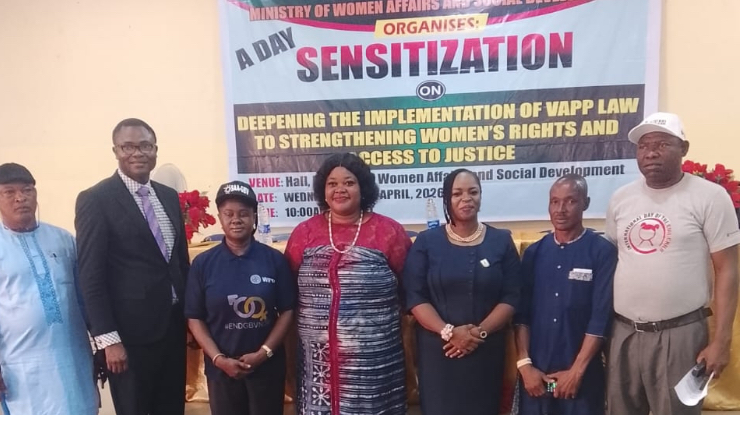
Stakeholders in Ondo State have renewed calls for a more coordinated response system to Gender-Based Violence (GBV), with emphasis on strengthening referral pathways and improving the practical enforcement of the Violence Against Persons Prohibition (VAPP) Law.
This formed the focus of a one-day sensitisation programme organised by the Ministry of Women Affairs in collaboration with the Ondo State Agency Against Gender-Based Violence (OSAA-GBV), aimed at improving institutional response to domestic violence and enhancing survivors’ access to justice.
The Commissioner for Women Affairs and Social Development, Dr. Seun Bosede Osamaye, said the state government remains committed to strengthening enforcement mechanisms and ensuring victims of gender-based violence are not denied justice.
She said the programme was designed to deepen understanding of referral systems and reinforce collaboration among stakeholders handling cases of abuse.
Osamaye stressed that gender-based violence extends beyond physical attacks, noting that emotional and psychological abuse are equally destructive and often overlooked.
She warned that such forms of abuse can result in long-term mental health challenges, affecting victims’ productivity, wellbeing and ability to function effectively in society.
The commissioner also identified emotional neglect as a growing concern in many households, adding that lack of care and support within families can have serious psychological consequences.
She commended OSAA-GBV for convening the engagement, saying continuous sensitisation is key to improving response capacity among stakeholders.
Osamaye urged participants to take the message back to their communities to help reduce the prevalence of gender-based violence, particularly in rural areas.
On child protection, she expressed concern over rising cases of neglect, especially of the girl-child, linking the trend to wider social issues such as substance abuse among some men.
She called on families to play a more active role in safeguarding children, stressing that prevention remains the most effective strategy.
“It is not enough to fight for justice after the damage has been done. We must do everything within our capacity to prevent such incidents from happening,” she said.
Osamaye also warned against lack of seriousness among participants at such trainings, urging them to prioritise learning and application of knowledge over financial incentives.
She reaffirmed the state government’s resolve to fully enforce the VAPP Law and ensure offenders are prosecuted, while also calling for stronger community-level responsibility in tackling drug abuse and other social vices that fuel violence.
In her welcome address, the Executive Director of OSAA-GBV, Barr. Bolanle Afolabi, said the forum was convened to assess how effectively existing laws and institutions are responding to gender-based violence in the state.
She said it was important to evaluate whether legal frameworks were translating into real protection and justice for survivors.
According to her, the programme was also aimed at identifying gaps in response mechanisms and strengthening collaboration among key actors.
Afolabi noted that although the VAPP Law has increased awareness and reporting of cases, effective implementation remains a challenge.
She disclosed that law enforcement agencies, including the police and the Nigeria Security and Civil Defence Corps, have received training, while partnerships with FIDA and other civil society organisations continue in providing legal and psychosocial support for survivors.
Also speaking, the Chairperson of the International Federation of Women Lawyers (FIDA), Ondo State branch, Barr. Bolanle Olafunmiloye, called for a critical assessment of how the VAPP Law is being implemented in practice.
She said while the law is in place and being utilised, there is a need to examine its real impact on victims and survivors.
Olafunmiloye said the engagement brought stakeholders together to identify challenges and develop practical solutions to improve responses to gender-based violence.
She noted that there has been increased awareness and reporting since the law came into force, describing it as a positive development.
She added that law enforcement agencies and legal practitioners are increasingly collaborating with civil society organisations to support victims through legal aid and psychosocial services.
However, she said institutional challenges still persist and called for stronger coordination among stakeholders to ensure the VAPP Law delivers on its objectives.